
Reflection

Reflection allows me to examine a problem or an idea more deeply. It is an important step that precedes the conception of a project. It allows me to assess an idea and the various forms it might take. How easily or with what difficulty I can imagine and weigh the different possible combinations determines how quickly I am ready to go forward.
For painting projects, my reflection usually begins when I find myself looking at a scene that I appreciate, that intrigues me, that moves me. If it sparks an idea—even a fleeting one—I capture the moment in a photograph.
Such a spark was ignited in my mind while visiting the village of Compton in the Eastern Townships in June 2020. I was instantly drawn to a charming, weathered wooden house. Three years later, I went back and I fell under its spell all over again. As a bonus, I found the play of light and shadow on the facade particularly interesting.

Back home, despite its attraction, I was puzzled about how I could translate this into a painting. I saw certain details that needed to be eliminated. Among others, the sky, as it was then, didn’t inspire me. What composition could I use to transform it into an interesting painting? The “creative” solution didn’t come to me right away, so I decided to continue my reflection.
In the fall of 2025, while watching storm clouds forming, I thought I’d like to capture them in a painting, but the scene beneath those clouds was rather mundane. Shortly after, the idea of placing cumulonimbus clouds building over the house in Compton began to take shape.
Finally, in January 2026, I decided to undertake this carefully considered project. The choice of a vertical composition and the large format (40 inches by 30 inches) prevailed naturally.
Concept
With a pencil, I traced the main lines of the house and sketched the shape of the clouds forming above it, taking care to leave a gap on the left side to ensure the effect of the sun’s rays on the house were believable.
I applied the base layers, starting with the sky, to build my confidence in this concept. I took care to protect the clean lines of the architecture with masking tape. This allowed me to preserve the drawing without having to overly fuss with painting around it.
Application of base layers, starting with the sky and the vegetation around the house.
I then focused on the darkest areas of the house. I waited a few days before painting the front facade to prevent bleeding between the dark and light sections.
Painting the dark sections of the house and leaving tehm to dry before adding the lighter colours.
Once most of the elements were in place, the “finishing touches” could begin. The clouds and foliage were more clearly defined. Adding a path and herbaceous plants helped anchor the foreground. The interplay of light and shadow in the vegetation created an overall sense of harmony.
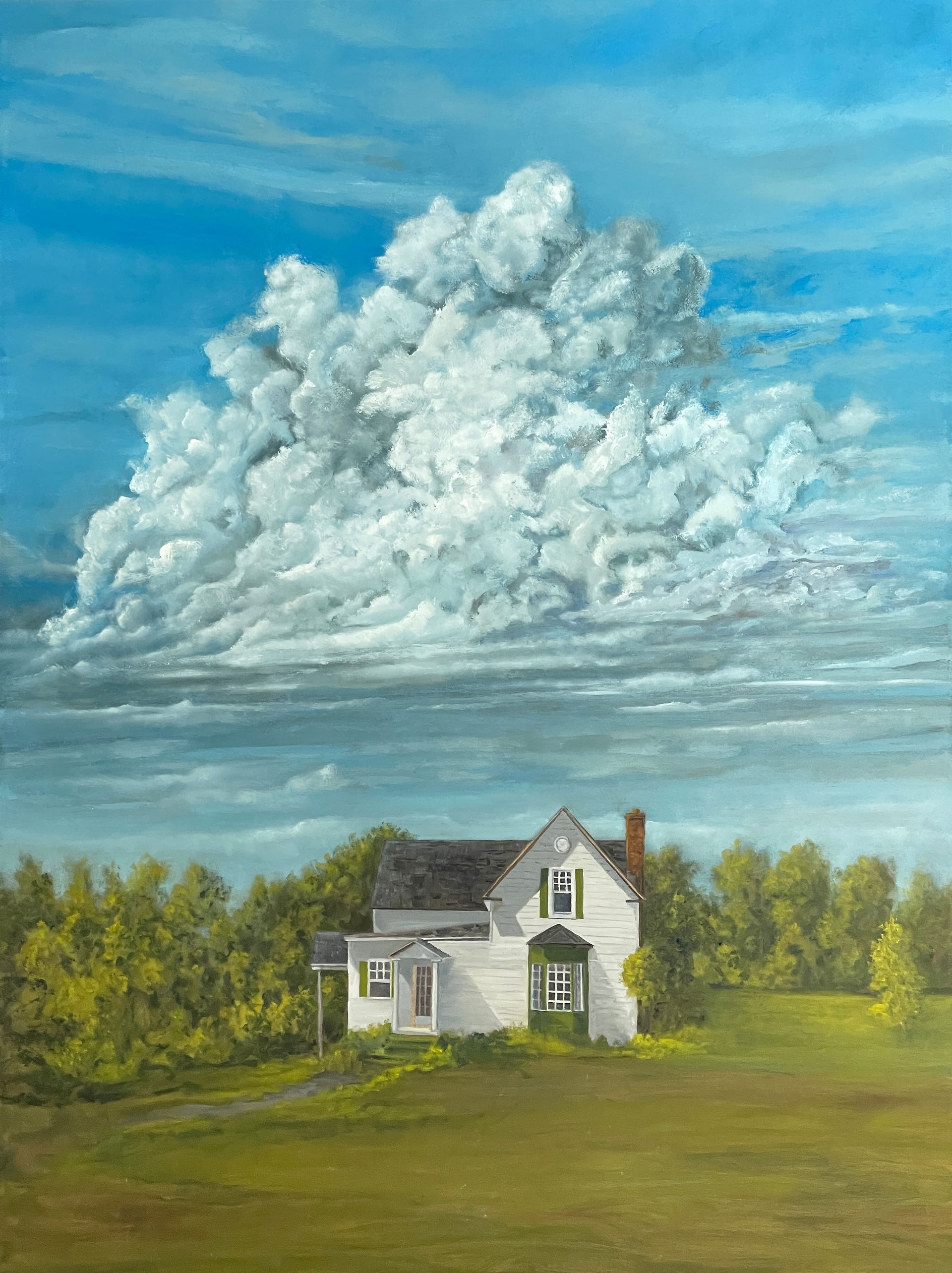

«Before the Storm», oil on gallery canvas, 40 in. x 30 in., 2026
Lise St-Arnaud, all rights reserved
I find that the contrast between the house bathed in slanting sunlight and the looming threat of a rainstorm in this painting adds a dramatic dimension to the visual narrative.
Lise. I love this painting. The clouds and house are equally interesting. My eye moves back and forth between them.